· Geographic Paradoxes · 4 min read ·
How the 40-Month Allied Occupation of Smyrna Erased an Ancient Mediterranean World
In May 1919, Allied warships escorted Greek troops into Smyrna. Forty months later, an ancient cosmopolitan civilization dissolved into ash and sea.
On the morning of 15 May 1919, the Gulf of Smyrna was crowded with Allied dreadnoughts. British, French, Italian, and American warships rode quietly at anchor as Greek transport ships pulled alongside the Cordon, the city’s paved waterfront promenade. Thousands of Greek residents surged against the seawall, waving blue-and-white flags and throwing flowers beneath the boots of the disembarking soldiers of the 1st Greek Division. Across the harbor, Ottoman officers and Turkish residents watched from the Konak government palace in silence. Within hours of the landing, gunshots near the Ottoman barracks triggered a chaotic crossfire that left dozens dead on the quay, shattering the premise that foreign military intervention could peacefully partition the collapsing Ottoman Empire.
For centuries, Smyrna had operated as the Aegean’s premier merchant hub, home to an intricate mosaic of Greeks, Turks, Armenians, Jews, and European Levantines. The city was widely known as “Gavur Izmir” (Infidel Izmir) among inland Anatolian Turks due to its cosmopolitan character, European cafes, and predominantly Christian commercial districts. The landing was authorized by British Prime Minister David Lloyd George, French Premier Georges Clemenceau, and American President Woodrow Wilson during the Paris Peace Conference. Alarmed by Italian territorial ambitions in southern Anatolia, the Allied leaders greenlit a Greek military zone to protect Christian populations and enforce wartime armistice terms.
 Figure 1: The territorial claims presented by Greek Prime Minister Eleftherios Venizelos at the Paris Peace Conference in 1919, seeking to annex western Anatolia.
The diplomatic architect behind the deployment was Greek Prime Minister Eleftherios Venizelos. At Paris, Venizelos presented maps projecting a “Greater Greece” that spanned both shores of the Aegean Sea, reviving the long-cherished nationalist vision known as the Megali Idea. Under the subsequent 1920 Treaty of Sèvres, Greece received administrative control over Smyrna and its surrounding hinterland for five years, after which a local plebiscite would determine whether the territory joined Greece permanently. However, the treaty existed largely on paper. In the rugged interior of Anatolia, Mustafa Kemal rejected the partition of the Turkish heartland and began organizing a rival nationalist government based in Ankara.
 Figure 2: Greek troops disembarking along the Smyrna quay on 15 May 1919 under Allied naval escort.
To govern the new zone, Athens dispatched Aristeidis Stergiadis as High Commissioner. Stergiadis was an austere Cretan lawyer with a reputation for uncompromising fairness. Rather than indulging local Greek triumphalism, he imposed strict martial regulations designed to protect Muslim civil rights, prosecuted Greek soldiers guilty of looting, and founded the Ionian University to educate Christians and Muslims alike. Stergiadis alienated both sides: Greek military leaders considered him hostile to their national ambitions, while Turkish residents viewed his administration as an illegitimate foreign occupation backed by bayonets.
 Figure 3: Greek garrisons in Smyrna during the administration of High Commissioner Aristeidis Stergiadis.
The defensive zone around Smyrna quickly proved uncontainable. Turkish irregulars and Kemalist forces repeatedly harassed the occupation perimeter, drawing Greek commanders into punitive expeditions deeper into the interior. When political shifts in Athens ousted Venizelos and restored King Constantine I in late 1920, the Allies quietly withdrew their diplomatic and logistical backing. Despite losing Allied support, the Greek high command launched an ambitious offensive in 1921 aimed at capturing Ankara and destroying the nationalist army. The expedition pushed hundreds of miles into the barren central plateau, stretching supply lines to the breaking point before stalling at the Battle of the Sakarya.
 Figure 4: Greek soldiers retreating across western Anatolia in late summer 1922 before the Turkish capture of the city.
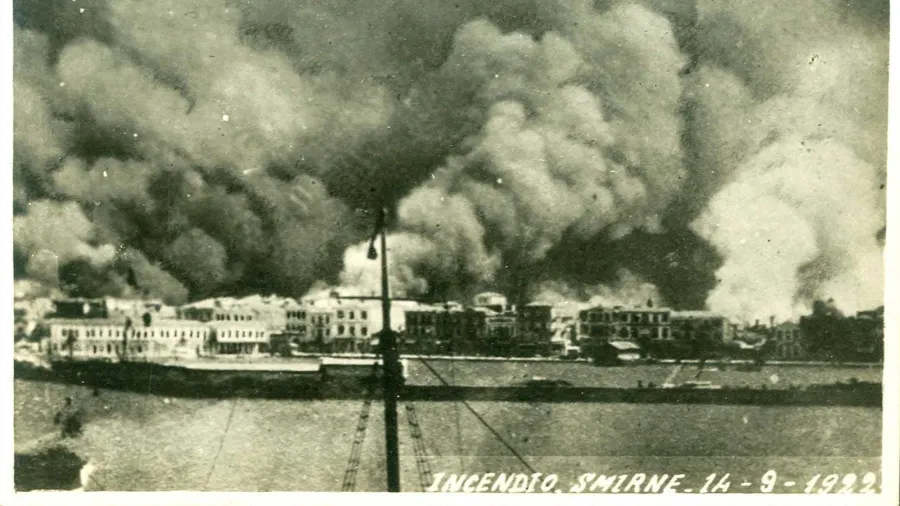
In August 1922, Kemal launched the Great Offensive, puncturing Greek defensive lines outside Afyonkarahisar and turning the retreat into a headlong rout. Greek divisions fell back in disorder toward the Aegean, leaving destroyed villages and thousands of fleeing refugees in their wake. On 9 September 1922, Turkish cavalry entered Smyrna, bringing the forty-month Greek administration to an abrupt end. Four days later, a fire ignited in the Armenian quarter and raced across the waterfront, consuming the city’s European, Greek, and Armenian districts while hundreds of thousands of panicked refugees clustered on the quayside.
The catastrophic climax of the occupation triggered the 1923 Treaty of Lausanne, which formally replaced the defunct Treaty of Sèvres. Attached to the peace accord was a compulsory population exchange protocol that uprooted roughly 1.2 million Orthodox Christians from Anatolia and 400,000 Muslims from Greece. Smyrna was rebuilt as the modern Turkish port of İzmir, its ancient Hellenic and Levantine communities gone forever. The forty months that began with flowers on the Cordon ended by dismantling an interconnected Aegean world that had endured for nearly three thousand years.