· Castles & Palaces · 4 min read ·
Why the Pope Financed the Cliffside Fortress of Nutjak on the Ottoman Frontier
Perched over Croatia's Cetina River canyon, the 15th-century stronghold of Fort Nutjak marked the knife-edge frontier between Venice and the Ottoman Empire.
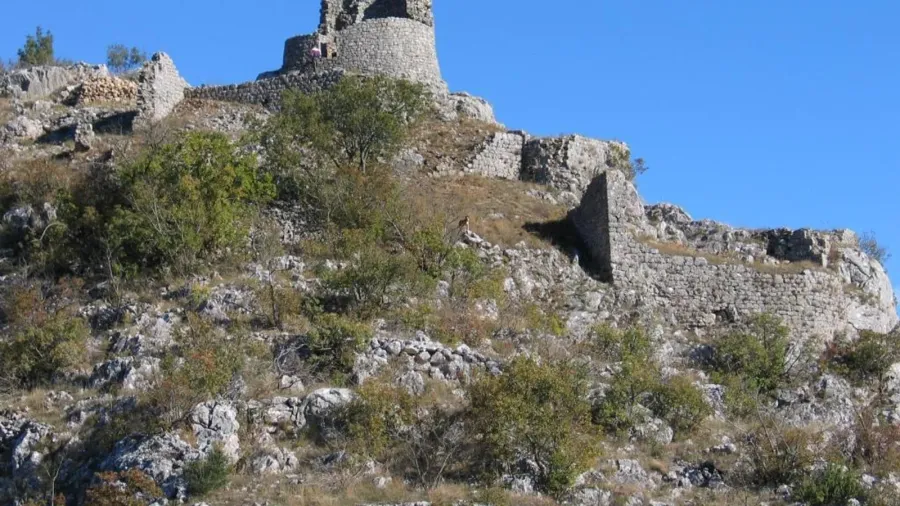
High above the emerald ribbons of the Cetina River in the Dalmatian hinterland, limestone crags plunge vertically into a shadow-filled gorge. Perched precariously on the lip of this chasm, three kilometers south of the crossing at Trilj, stand the sun-bleached ramparts of Fort Nutjak. In the twilight of the fifteenth century, this solitary stone outpost was regarded across Christendom as one of the most vital strategic hinges in southern Europe. So acute was the existential threat of Ottoman cavalry sweeping westward through the Balkan valleys that in 1492, from his sickbed in Rome, Pope Innocent VIII took the extraordinary step of directly financing the fort’s garrison and structural upkeep.
The Guardian of the Republic of Poljica
Fort Nutjak was commissioned around 1490 by Duke Žarko Dražojević, the charismatic military leader of the Republic of Poljica. Poljica was a rare political anomaly: an autonomous peasant-noble commonwealth nestled between the Mosor Mountains and the Adriatic Sea, governed by its own egalitarian medieval legal code. As the armies of Sultan Bayezid II pushed steadily into the Bosnian interior, Dražojević recognized that the Cetina River formed the last natural water barrier shielding the Dalmatian coastline and the maritime republic of Venice.
To anchor this riverine frontier, Dražojević erected Nutjak on a rugged promontory where the Cetina breaks free from the wide plateau of Sinjsko Polje and carves a winding, inaccessible canyon toward Omiš. Archaeological excavations indicate the medieval masons built directly atop a prehistoric Illyrian hillfort, utilizing the natural terrain to make direct frontal assault impossible. Even though Dražojević repeatedly offered to sell the fortress to Venice between 1499 and 1504 to ensure professional naval reinforcement, the duke retained personal command until his death in battle in 1508.
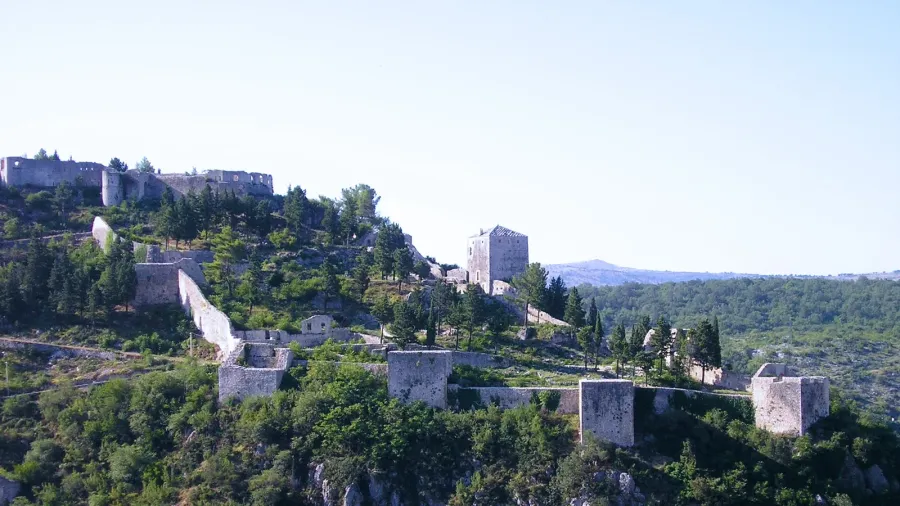
 Figure 1: The imposing circular stone tower of Fort Nutjak clings to the sheer limestone crag above the Cetina River gorge.
Architecture of Mountain Warfare
The fortress design is dominated by an imposing circular stone tower constructed from partially dressed limestone blocks bound with thick lime mortar. Measuring several stories in height, the tower features an interior infill of dense rubble and broken stone designed to withstand early gunpowder cannon bombardment. To the west, the main entrance was protected by a fortified wall seven meters long and four meters high, channeling any attackers through a constricted, easily defended approach.
Inside the outer perimeter, an irregular courtyard contained barracks, ammunition storage, and living quarters for a garrison of twenty to thirty soldiers. Because resupply along the steep cliff tracks was perilous, the fort incorporated rainwater cisterns chiseled directly into the bedrock.
 Figure 2: The ruins of Fort Nutjak command the strategic choke point where the Cetina River leaves the Sinjsko Polje plateau.
A Frontier Across a River
Despite its defensive strength, Nutjak was overwhelmed and captured by the Ottomans around 1513. Integrated into the Sanjak of Klis under the judicial authority of the kadi of Imotski, the citadel was placed under an Ottoman fortress commander (dizdar). For nearly two centuries, Nutjak operated as an imperial watchpost guarding the Ottoman crossing points against Venetian coastal skirmishers.
The geopolitical balance shifted dramatically during the Morean War. In March 1685, local Poljica insurgents successfully stormed the citadel and drove out the Ottoman defenders. The conflict culminated in the landmark 1699 Treaty of Karlowitz, which drew an international border straight down the middle of the riverbed. Venice was formally awarded Fort Nutjak on the western bank, while the Ottoman Empire retained the opposite shore and the neighboring fortress of Čačvina. For decades, soldiers of two hostile world powers stared at each other across the narrow gorge, separated only by the rushing currents of the Cetina.
Decay and Preservation of a Border Monument
When Venetian forces captured the inland stronghold of Imotski in 1717, pushing the Ottoman border far into the interior, Nutjak’s frontline defensive utility evaporated. The Venetian authorities constructed a smaller surveillance post nearby at Gardun, leaving Nutjak to the elements. By the nineteenth century, the wooden floors had collapsed and the masonry was crowned by wild fig trees and brambles.
Today, Fort Nutjak is officially protected as a cultural monument of the Republic of Croatia. Standing atop the limestone precipice, its circular stone tower remains an eloquent sentinel of Dalmatia’s frontier history, an enduring symbol of a vanished peasant republic and the papal fears that helped carve its stones into the cliffside.