· Castles & Palaces · 5 min read ·
Why the Ming Dynasty's Unconquered Turtle Fortress Is Being Swallowed by Sand
Built in 1608 as an unbreachable Ming stronghold, the turtle-shaped rammed-earth citadel of Yongtai is slowly succumbing to the encroaching Gobi Desert.
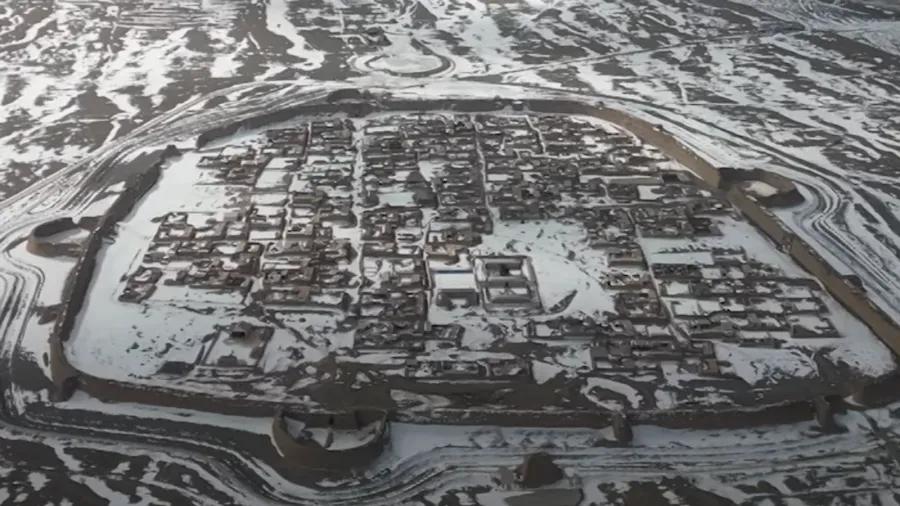
On the desolate fringes of the Tengger Desert in northwestern China, a biting wind sweeps over an arid expanse of cracked clay and yellow dust. From ground level, the towering twelve-meter-high rammed-earth ramparts look like an organic extension of the barren loess hills, but an aerial view reveals a startling design: the entire perimeter is shaped like a colossal turtle resting upon the desert floor. Erected in 1608 during the Wanli reign of the Ming Dynasty, Yongtai Fortress was engineered to be an impregnable frontier outpost capable of withstanding siege warfare and nomadic cavalry raids. Yet four centuries after defying hostile armies without ever falling in battle, this legendary “Turtle City” is slowly being conquered by an adversary its builders never anticipated: shifting sand and chronic desertification.
The Golden Tortoise of the Hexi Corridor
In the late sixteenth century, the Ming court faced persistent incursions from Mongol and Tatar confederations pushing south from the northern steppes toward the Yellow River. Following the Battle of Songshan in 1598, imperial generals resolved to fortify the Gansu frontier by constructing the “Songshan New Border,” a defensive line designed to seal off vital mountain passes and secure the eastern gateway to the Silk Road. In 1607, military architects began erecting Yongtai as the core command citadel of this desert garrison.
Thousands of soldiers and laborers completed the entire fortress in fifteen months. The builders chose a turtle-shaped layout not merely for zoomorphic aesthetics, but for profound tactical and geomantic reasons. In traditional Chinese cosmology, the Black Tortoise (Xuanwu) symbolized northern defense, stability, and enduring longevity. Tactically, the design was brilliant: the southern gate and its fortified barbican (wengcheng) served as the turtle’s head, the western and eastern secondary gates formed its front flippers, the northern gate and its adjoining signal tower mirrored its tail, and the circular perimeter wall mimicked the creature’s shell.
 Figure 1: The imposing rammed-earth ramparts of Yongtai Fortress rise twelve meters above the Gansu plateau, preserving four centuries of frontier military engineering.
Rammed Earth, Barbicans, and Powder Smoke
The architectural execution of Yongtai relied on ancient Chinese rammed-earth (hangtu) construction. Layers of local loess soil, sand, clay, and gravel were mixed with sticky water solutions and pounded inside wooden frameworks until the ramparts hardened into near-concrete density. Stretching 1.7 kilometers in circumference, the walls measured six meters wide at the top and twelve meters at the base, creating a fortification that absorbed cannon impacts without fracturing.
A garrison of two thousand infantrymen and five hundred cavalry units, accompanied by eight hundred horses, was permanently stationed within its walls. The interior was organized into a self-sustaining military city, complete with grain warehouses, an armory, drill grounds, stables, and a deep perimeter moat that was six meters wide and two and a half meters deep. Surrounding the fortress, a network of signal towers stretched for dozens of kilometers across the desert, allowing watchmen to signal approaching threats back to regional headquarters using smoke by day and fire by night.
 Figure 2: Built during the reign of the Wanli Emperor, Yongtai reflected the sophisticated military architecture deployed across the Ming Empire to secure imperial borders.
The Slow Retreat Against the Encroaching Dunes
Yongtai fulfilled its military mission with remarkable success. Over centuries of border unrest and the eventual transition from the Ming to the Qing Dynasty, the fortress was never breached by force of arms. When imperial border defense needs faded in the eighteenth and nineteenth centuries, the garrison demobilized, and the soldiers’ descendants settled down within the protective walls, farming the surrounding alluvial plains fed by mountain runoff.
In the 1950s, Yongtai was still an active agricultural settlement home to over fifteen hundred residents and eight hundred households. Inside, a handsome Republican-era primary school was constructed in the 1920s, blending Western neoclassical elements with ornate Chinese brick carving. However, ecological collapse soon overtook the oasis. Overgrazing, groundwater depletion, and climate-driven drought caused local springs to dry up and the surrounding grassland to degrade into sandy wasteland.
The Final Watch of the Desert Citadel
By the early 2000s, living conditions had deteriorated to the point where the government initiated ecological migration programs, relocating hundreds of families to newly irrigated valleys. Today, fewer than one hundred residents remain inside the earthen shell, most of them elderly shepherds who lead flocks of sheep through the historic south gate at dawn and return at dusk.
Wind, winter frost, and scouring sandstorms continue to erode the centuries-old battlements, leaving deep vertical fissures in the clay parapets. Recognized as a Major National Historical and Cultural Site, Yongtai has recently undergone targeted structural stabilization to prevent flood washouts and collapse. Standing solitary against the barren skyline of Gansu, the “Turtle City” endures as a poignant monument to human tenacity, an ancient citadel that triumphed over the weapons of war only to face the silent, unstoppable tide of the desert.