· Borders & Frontiers · 3 min read ·
Walls of Cuéllar: Spain's Forgotten Triple-Ring Fortress
Rising above the plains of Segovia, the medieval walls of Cuéllar preserve three concentric defensive rings and rare Mudéjar military gate arches.
Walls of Cuéllar: Spain’s Forgotten Triple-Ring Fortress
Across the high plateau of Castile and León, the town of Cuéllar stands upon a limestone ridge overlooking the Cega river basin. While many travelers know the celebrated ramparts of Ávila, fewer venture fifty kilometers north to discover a defensive complex that rivaled the greatest military fortifications of medieval Iberia. The Walls of Cuéllar constitute one of the most extensive and strategically sophisticated medieval fortifications in central Spain, engineered across centuries to withstand both sieges and political turbulence.
The origins of these ramparts trace to the eleventh century, following the Christian repopulation of the Duero river valley. Strategically positioned between Segovia and Valladolid, Cuéllar served as a vital frontier stronghold during the Reconquista. The medieval builders conceived not a single defensive line, but a complex series of three distinct walled enclosures: the lower city perimeter, the inner citadel, and an outer counter-wall. Archaeological excavations have even uncovered the foundations of a vanished fourth defensive circuit, demonstrating how the settlement adapted to shifting threats over several hundred years.
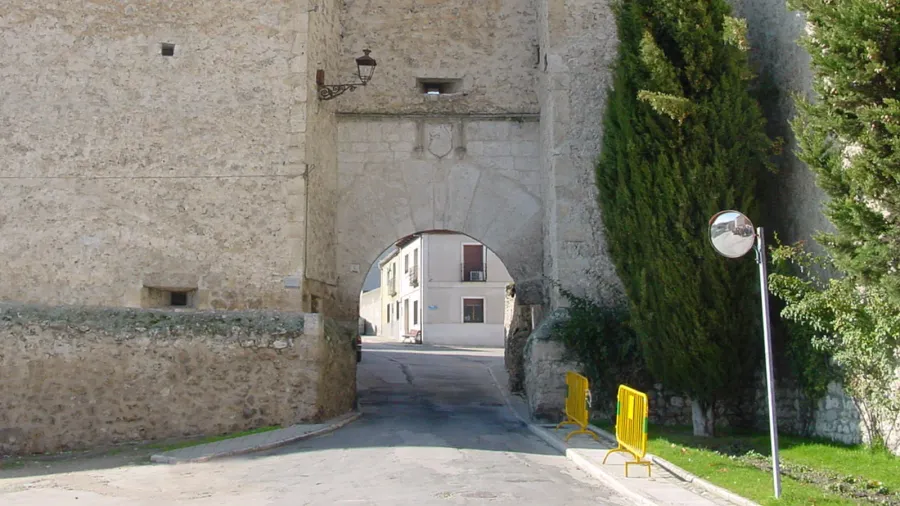
 Figure 1: The Mudéjar-style Arch of San Basilio, featuring defensive masonry and classic horseshoe arch construction.
At their peak, the fortifications stretched over 2,000 meters in total perimeter. Today, approximately 1,400 meters survive in varying states of preservation, presenting a formidable silhouette against the Castilian sky. Constructed from solid limestone masonry and rubble infill, the curtains measure 1.5 meters in thickness and rise to average heights exceeding five meters. Seven of the original eleven gates remain standing, each engineered with specialized defensive angles to trap besiegers in flanking crossfire.
The architecture reflects a fascinating convergence of cultural techniques. Christian military engineers integrated Mudéjar craftsmanship, utilizing fired brick and horseshoe arches that mirror the fourteenth-century military installations of Toledo. The Arch of San Basilio stands as an exceptional specimen of this hybrid tradition, combining Islamic structural geometry with Romanesque stone bastions.
 Figure 2: The Arch of La Magdalena, one of seven surviving historic portals granting access through the citadel enclosures.
During the fifteenth century, the lordship of Cuéllar passed to Francisco Fernández de la Cueva, the second Duke of Alburquerque. The Duke initiated an ambitious modernization program, reinforcing the battlements with artillery platforms and integrating the fortress castle into the city walls. This transformed Cuéllar into an impregnable ducal seat capable of resisting early gunpowder armaments.
By the seventeenth century, shifting geopolitical borders and centralized monarchical rule diminished the military utility of the fortress. Over the subsequent two centuries, neglect and quarrying took a heavy toll. Local residents removed stones for domestic construction, while landslides and erosion collapsed roughly a quarter of the perimeter.
 Figure 3: Preserved curtain wall along the Arch of San Martín section, revealing centuries of stonework and adaptation.
Official recognition arrived in 1931 when the Spanish Republic declared the walls and castle a National Artistic Monument (Bien de Interés Cultural). Initial stabilization efforts began in the 1970s, but the definitive revival took place between 2008 and 2011. Supported by a 3.4 million euro grant from the Ministry of Housing and European regional development funds, specialists carefully restored the masonry, consolidated the parapets, and opened elevated walkways to the public. Today, the ramparts of Cuéllar stand as an enduring masterwork of Iberian military engineering.