· Earth Extremes · 3 min read ·
Why the Highest Peak in Southern Africa Was Named a Beautiful Little Mountain
Rising 3,482 meters above Lesotho, Thabana Ntlenyana is southern Africa's highest summit, commanding an astounding 3,003-kilometer topographic solitude.
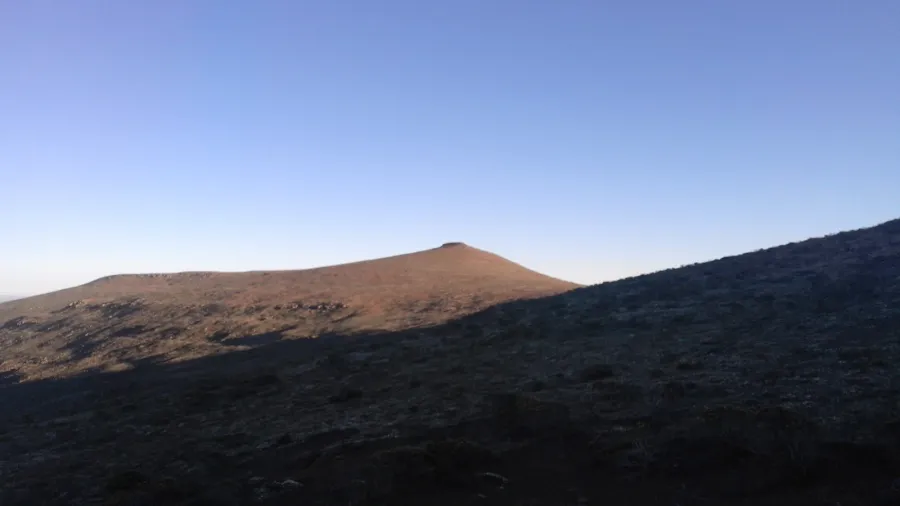
Across the high tablelands of eastern Lesotho, the wind whips across frozen scree at negative eight degrees Celsius, scouring an undulating sea of dark volcanic rock. There are no razor-sharp granite needles or snow-capped spires piercing the clouds here. Instead, the highest point on the entire southern half of the African continent presents itself as a deceptively gentle mound of weathered basalt, rising quietly from the Mohlesi ridge. When local Basotho herders gazed upon this rounded crest, they did not christen it with a fearsome epithet; they named it Thabana Ntlenyana, translating from Sesotho as the “beautiful little mountain.”
The Paradox of an Understated Continental Crown
At 3,482 meters (11,424 feet) above sea level, Thabana Ntlenyana easily surpasses every other summit south of the East African Rift. Yet its visual subtlety masks one of the most extreme geographic statistics on Earth. The peak ranks eleventh in the world by topographic isolation. To find any piece of land standing taller than this basalt rise, one must scan past the Kalahari, over the Zambezi basin, and beyond the Great Lakes to Mount Loolmalasin in northern Tanzania, a distance of 3,003 kilometers (1,866 miles).
 Figure 1: The Drakensberg alti-montane ecoregion encompasses the high-altitude plateau of Lesotho, where Thabana Ntlenyana anchors the Afro-alpine biome.
This immense isolation means that Thabana Ntlenyana presides over an uninterrupted geographic dominion wider than the Mediterranean Sea. The peak anchors the high Maloti range within Lesotho, a nation possessing the highest lowest-point of any sovereign country on the planet, with its entire territory elevated more than 1,000 meters above sea level.
Volcanic Origins and the Continental Sponge
The geological foundations of Thabana Ntlenyana date back approximately 180 million years to the breakup of the supercontinent Gondwana. Cataclysmic volcanic fissures tore through southern Africa, pouring thousands of meters of thick flood basalt across older Triassic sandstones. Over geological epochs, dramatic erosion carved the legendary sheer cliffs of the Great Escarpment along the Drakensberg border, leaving Thabana Ntlenyana as an erosion-resistant basalt remnant resting just behind the precipice.
 Figure 2: The gradual basalt slope approaching the summit of Thabana Ntlenyana belies its continental stature.
The porous, stepped lava flows of this Afro-alpine plateau function as southern Africa’s most vital hydrological sponge. Snowmelt and seasonal rains soaking into the moss bogs and tussock grasses around Thabana Ntlenyana feed the infant tributaries of the Senqu River. As this water cascades westward, it becomes the Orange River, carving a 2,200-kilometer path across desert plains to discharge into the Atlantic Ocean. The runoff collected from these basalt slopes sustains agriculture, industry, and municipal life across South Africa, Namibia, and Lesotho.
Life in the Afro-Alpine Cryosphere
Surviving on Thabana Ntlenyana demands radical adaptation to an unforgiving climate. Categorized within the Drakensberg alti-montane grasslands ecoregion, the summit environment endures violent summer lightning storms, severe winter blizzards, and relentless frost-heaving. Tree growth is biologically impossible at this altitude; vegetation consists of specialized ericoid shrubs, sedges, and hardy tussock grasses like Merxmuellera drakensbergensis.
 Figure 3: Seen across the Drakensberg escarpment from Giant’s Castle Ridge, the peak crests the undulating volcanic plateau of the Maloti range.
Despite the harshness, this skyward enclave supports a specialized alpine fauna. Endemic avian species navigate the rocky outcrops, including the Drakensberg rockjumper, the Drakensberg siskin, and the sickle-winged chat. While the precipitous drops of the neighboring Sani Pass attract global mountaineering attention, Thabana Ntlenyana stands apart in serene isolation, an understated dome of ancient lava that silently rules the skies of southern Africa.