· Culture & Arts · 3 min read ·
Shashmaqam: The Classical Court Music of the Silk Road Oases
Preserved in the ancient courts of Bukhara and Samarkand, this classical modal tradition weaves Sufi poetry and plucked lutes into six complex musical suites.
Across the oasis cities of Transoxiana, where Silk Road caravans traded silk, spices, and paper, an intricate classical musical tradition took root in royal palaces and urban courtyards. In the historic centers of Bukhara and Samarkand, now located across Uzbekistan and Tajikistan, master musicians cultivated a repertory known as Shashmaqam. The term derives from the Persian words for six modes, referring to the six grand musical suites that comprise the foundation of classical Central Asian art music.
Each of the six suites, Buzruk, Rost, Navo, Dugoh, Segoh, and Iroq, functions as an extended cyclic work comprising dozens of vocal and instrumental movements. Unlike simple folk tunes, these compositions follow strict theoretical rules governing modal progression, rhythmic cycles, and lyrical improvisation. For centuries, court patronage under the Emirs of Bukhara provided the formal setting where Jewish, Tajik, and Uzbek musicians gathered to refine and transmit this complex oral art form across generations.
 Figure 1: Traditional folk music ensemble in Central Asia performing modal suites with acoustic lutes and frame drums.
The acoustic architecture of the modal suites
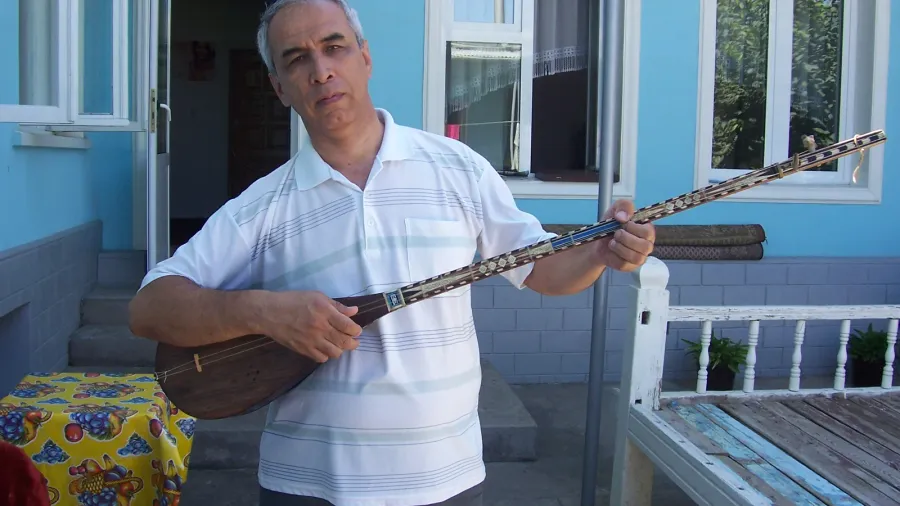
The structure of Shashmaqam pairs austere acoustic instrumentation with complex vocal ornamentation. The core ensemble centers on long-necked lutes, particularly the two-stringed dutar and the steel-strung tanbur, which establish the melodic microtones of each mode. The bowed sato adds sustained string textures, while the doira, a circular frame drum fitted with metal jingles, drives the intricate metric cycles known as usul.
Performers do not rely on written notation, passing down microtonal pitch variations and rhythmic structures through direct master-apprentice instruction known as ustod-shogird. Vocalists deliver verses drawn from classical Persian and Chagatai Turkic poetry, setting the mystical writings of poets like Hafez, Jami, Navoiy, and Bedil to music. These texts use allegories of worldly devotion to explore Sufi themes of divine love, separation, and spiritual return.
 Figure 2: An Uzbek musician plucking the two-stringed long-necked dutar, providing the modal foundation for vocal suites.
Preservation and political shifts along the Silk Road
The political upheavals of the twentieth century altered the social context of Shashmaqam. Following the Bolshevik revolution and the fall of the Emirate of Bukhara in 1920, Soviet cultural authorities sought to standardize regional musical traditions. State musicologists transcribed the oral repertory into Western notation, establishing state conservatories in Tashkent and Dushanbe while organizing large orchestral choirs that replaced traditional intimate gatherings.
Despite institutional reorganization, the master-apprentice transmission chain survived within family lineages, particularly among Bukharian Jewish and Tajik musical dynasties. When massive emigration occurred in the late twentieth century, master performers carried the tradition to international diaspora communities in Tel Aviv and New York, preserving regional variations that had vanished from Central Asian concert halls.
 Figure 3: Traditional vocalists accompanied by long-necked lutes in Samarkand, performing verses from classical Sufi poetry.
Global recognition and living practice
In 2003, UNESCO recognized Shashmaqam as a Masterpiece of the Oral and Intangible Heritage of Humanity, later inscribing it on the Representative List of the Intangible Cultural Heritage of Humanity in 2008. This international recognition stimulated renewed interest across Central Asia. Today, specialized academies in Uzbekistan and Tajikistan train a new generation of instrumentalists and singers in the traditional microtonal system.
As acoustic instruments resonate in restored courtyards and international auditoriums, Shashmaqam continues to connect contemporary audiences with the intellectual history of Central Asia. The music remains an enduring expression of centuries of cross-cultural dialogue, preserving a living bridge between sacred literature, mathematical modal theory, and communal performance.