· Culture & Arts · 4 min read ·
How a Spanish Basilica Defied the Vatican to Keep Its Medieval Flying Machines
Suspended from a cathedral dome in southeastern Spain, mechanical clouds and wooden flying machines have lowered singing angels every August since the 1400s.
Every August, the stone nave of the Basílica de Santa María in Elche, Spain, fills with incense, candle smoke, and intense summer heat. Thirty meters overhead, a painted canvas representing the sky seals off the dome. Winches crank hidden gears in the attic, ropes tighten over wooden pulleys, and an aperture in the painted ceiling slides open. A crimson wooden sphere the size of a carriage descends slowly through the gap. Known as la magrana (the pomegranate), the structure splits open mid-air into eight curved segments, revealing a young boy dressed in gold silk who holds a palm branch and sings medieval verse above the crowd.
This two-act sacred drama, the Misteri d’Elx, has taken place in Elche every summer since the late fifteenth century. While liturgical plays once animated medieval churches across France, England, and Italy, almost all vanished hundreds of years ago under royal bans and church decrees. Elche remains the exception. Inside this basilica on the Mediterranean coast, medieval stage mechanics, vocal polyphony, and communal staging operate virtually unchanged from five hundred years ago.
The mechanical heaven under the dome
The staging of the play transforms the entire interior of the church into an engineering marvel. Across the transept, carpenters erect the cadafal, an elevated wooden platform where the primary earthly events unfold. A wooden ramp called the andador slopes down the central nave, connecting the main portal to the stage.
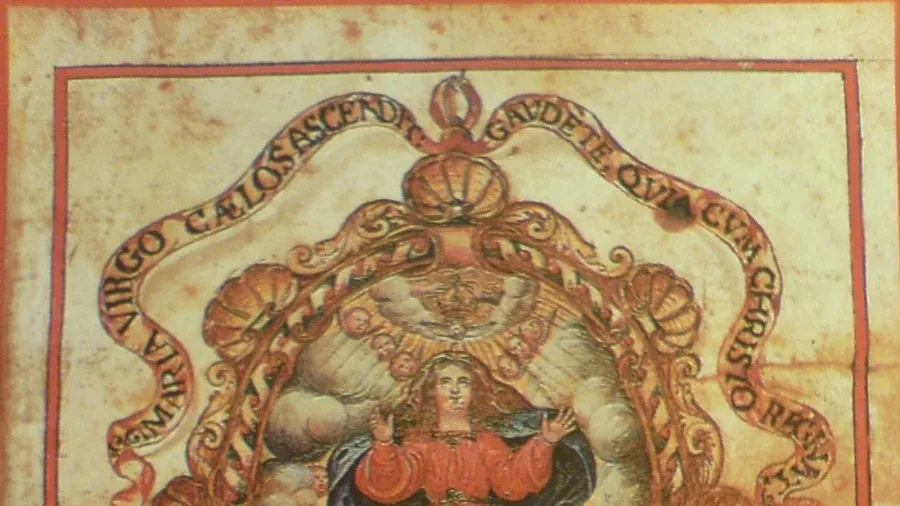
 Figure 1: The title page of the 1709 Consueta manuscript, which preserves the musical notation, stage directions, and Valencian text for the Mystery Play of Elche.
The most extraordinary engineering operates high above the congregation. Technicians stationed in the vault work a system of counterweights and heavy winches to lower actors into the sacred space. Following the descent of the pomegranate, a second mechanical apparatus called the Araceli descends from the ceiling. Shaped like an ornate gilded altar, the Araceli carries five singers: an ordained priest flanked by four young choristers, who accompany the Virgin Mary’s soul upward into the opening of the dome.
The machinery dates to the late Renaissance and early baroque periods, constructed of iron gears, hemp ropes, and stout timber frames. Stagehands follow handwritten prompt books called consuetas, which preserve stage directions, blocking notes, and four-part musical scores passed down across generations.
An outlawed drama saved by a papal bull
The survival of the Elche Mystery is an accident of political persistence. In 1563, the Council of Trent issued strict decrees prohibiting theatrical plays, secular instruments, and dramatic spectacles inside Roman Catholic houses of worship. Across Europe, clerical authorities dismantled stage platforms, burned pageant wagons, and expelled actors from cathedrals.
 Figure 2: The Magrana, a mechanical pomegranate constructed in the sixteenth century, opens its red petals to lower an angel toward the elevated cadafal stage.
The citizens of Elche refused to surrender their tradition. Local guilds and municipal leaders argued that the drama represented an act of civic devotion honoring the Assumption of the Virgin Mary, the town patron. For decades, local emissaries lobbied church authorities in Rome. In 1632, Pope Urban VIII issued an official apostolic brief granting the city a perpetual dispensation. The decree allowed the drama to continue inside the basilica indefinitely, granting Elche a legal exemption held by no other church on earth.
Polyphonic chords and the 1709 score
Musically, the performance captures a historical transition between two distinct musical eras. The earliest sections feature monophonic Gregorian plainchant originating in medieval religious foundations. Other passages incorporate complex polyphonic madrigals composed by sixteenth-century Spanish masters, including Ginés Pérez and Lluís Vich.
The libretto is sung almost entirely in old Valencian, with brief Latin verses reserved for liturgical moments. Because the acoustic space of the stone basilica was built before electronic amplification, performers project their voices along the wooden andador, allowing four-part vocal harmonies to bounce between the baroque side chapels.
A living medieval machine on the Mediterranean coast
Unlike modern museum exhibits or historical reenactments, the Mystery Play of Elche relies entirely on local residents. Singers, carpenters, riggers, and municipal organizers carry on roles held by their parents and grandparents. In 2001, UNESCO recognized the drama as one of the inaugural Masterpieces of the Oral and Intangible Heritage of Humanity, acknowledging its role as the only unbroken liturgical drama of medieval origin still staged inside a Christian sanctuary.
When the final act concludes on August 15, gilded paper stars drift down from the ceiling aperture as the Araceli ascends into the painted canvas sky. For five centuries, despite civil wars, epidemics, and counter-reformation decrees, the citizens of Elche have kept their mechanical heaven working above the stone floor of Santa María.