· Culture & Arts · 4 min read ·
Batik Kawung: Sacred Geometry of the Javanese Royal Courts
Carved onto ancient stone and reserved for Javanese royalty, the four-lobed Batik Kawung motif encodes deep cosmic balance and spiritual restraint.
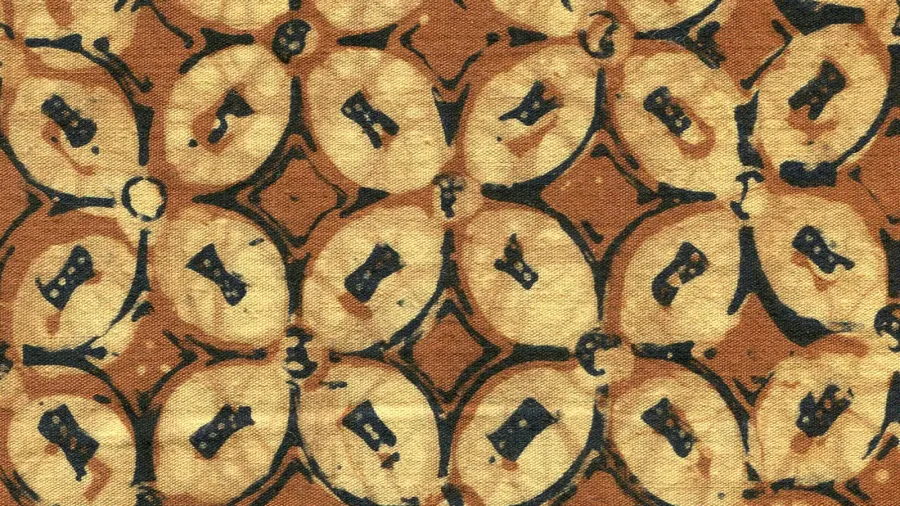
Across the royal courts of Central Java, textile design functioned as a strict codex of political status and cosmic order. Among the oldest recognized motifs in Indonesian textile history is Batik Kawung, an austere geometric arrangement of four intersecting ovals centered around a singular point. While popular perception often classifies batik as ornamental folk art, historical evidence from ancient Javanese kingdoms reveals that this four-lobed geometry carried the weight of royal law, philosophical discipline, and ancestral cosmology.
The earliest physical precursors of the pattern appear carved into thirteenth-century stone statues in East Java, notably temple reliefs associated with the Singhasari and Majapahit dynasties. Stone likenesses of deities and royal figures wear waist cloths adorned with interlocking four-petaled circles, proving that the geometry predated modern wax-resist techniques by several centuries.
 Figure 1: Archival sample of the Kawung kemplung pattern collected before 1891, preserved in the National Museum of World Cultures.
The Botanical Riddle: Palm Fruit or Sacred Lotus
Etymologists and cultural historians trace the word kawung along two distinct physical inspirations. The most common Javanese explanation links the motif to the cross-section of the kolang-kaling, the translucent oval fruit harvested from the sugar palm tree (Arenga pinnata). When cut horizontally, the fruit reveals four symmetrical chambers surrounding a central core. For agrarian Javanese societies, the sugar palm was an essential resource that provided roof thatch, fermented sap, sugar, and food. Drawing artistic inspiration from its resilient seed pod reflected deep integration with island ecology.
A parallel interpretation rooted in classical Hindu-Buddhist iconography views the four lobes as petals of an open lotus flower (padma). In classical Javanese philosophy, the lotus represents purity and long life because it roots in murky pond mud yet blossoms spotless above the water surface. Whether derived from the humble sugar palm or the sacred lotus, the design captures a natural balance where four outer structures protect a serene, empty center.
 Figure 2: Architectural carving displaying the fourfold Kawung geometry, echoing classical Javanese temple reliefs.
Cosmology and the Four Guardians
The geometric structure of Batik Kawung directly visualizes one of Java’s core cosmological concepts: Sedulur Papat Limo Pancer (Four Brethren, Five the Center). This belief holds that every human enters the physical world accompanied by four metaphysical guardians corresponding to the cardinal directions: north, south, east, and west. These four companions represent natural forces, passions, and elements that humans must master.
At the intersection of the four outer petals lies the fifth element: the divine soul and moral center of the individual. Wearing the Kawung motif served as an active spiritual reminder. The wearer was charged with subduing outward impulses, maintaining equilibrium against external turbulence, and governing with measured composure. The circular boundary encompassing each four-petal group represented self-containment, reminding court officials that power without restraint inevitably breeds ruin.
 Figure 3: Late nineteenth-century textile specimen illustrating Kawung picis, scaled to the diameter of small currency tokens.
Royal Decrees and the Forbidden Patterns
During the rise of the Mataram Sultanate in the seventeenth century, the central courts of Surakarta (Solo) and Yogyakarta institutionalized sumptuary laws known as Batik Parang Larangan (prohibited patterns). Under these edicts, specific motifs were legally restricted to rulers and immediate family members. Batik Kawung entered this guarded royal tier alongside motifs like Parang Rusak.
Court decrees stipulated that only the reigning monarch, crown prince, and high-ranking court ministers (sentana dalem) could wear garments bearing the Kawung design. Common subjects found wearing the pattern faced severe legal sanctions. The restriction was deliberate: court leaders believed that the visual discipline of the pattern reflected the purity required to govern. A ruler draped in Kawung announced his ability to control his senses and safeguard justice across the four corners of his realm.
Scale, Variants, and Modern Resilience
Javanese artisans classified Kawung patterns according to the size of the individual circular elements, often using everyday monetary units as scale benchmarks. The smallest traditional variant, Kawung Picis, featured ellipses roughly the size of a ten-cent Dutch colonial coin (picis). A medium version, Kawung Bribil, matched the scale of a half-cent coin, while Kawung Sen reflected the diameter of a one-cent piece. The largest configuration, Kawung Kemplung, displayed bold, expansive lobes several inches wide, reserved for theatrical performances and ceremonial court hangings.
Following Indonesia’s independence in the mid-twentieth century, royal sumptuary laws dissolved, opening Batik Kawung to craftsmen and citizens throughout the archipelago. Today, contemporary textile artists in Yogyakarta and Pekalongan continue to draw the motif using hot wax and brass canting pens, preserving an unbroken mathematical tradition. What originated as a sacred cipher carved into stone temples remains a cornerstone of Southeast Asian visual culture, articulating an ancient Javanese conviction that true authority begins with internal harmony.