· History & Civilization · 5 min read ·
Panam Nagar: The Abandoned 19th-Century Merchant City of Bengal
Lined with decaying neoclassical mansions, the abandoned merchant enclave of Panam Nagar preserves centuries of Bengal textile trade near Dhaka.
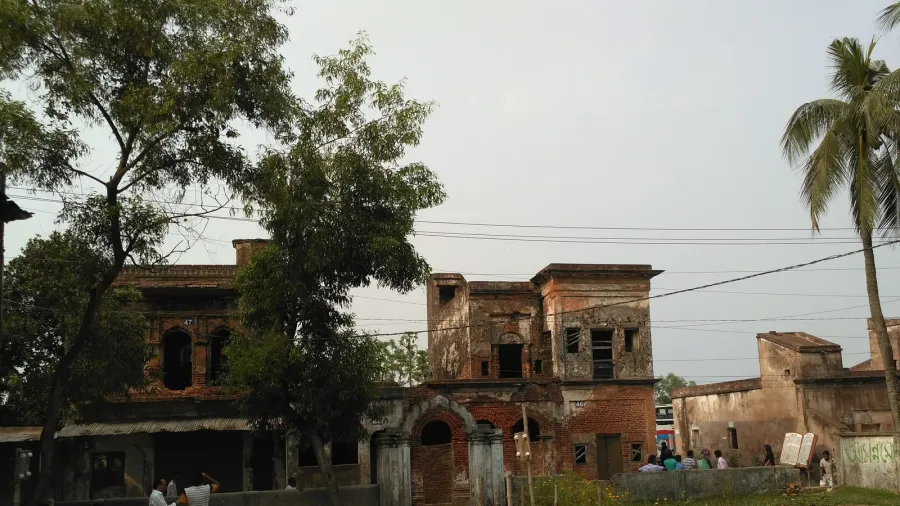
Situated within the Sonargaon Upazila of Narayanganj District, roughly thirty kilometers southeast of Dhaka, Panam Nagar stands as an intact urban artifact of Bengal’s commercial history. Comprising fifty-two historic brick structures distributed along a single six-hundred-meter street, the settlement reflects two distinct golden ages: its medieval origins as a suburb of the royal capital of Sonargaon, and its nineteenth-century reincarnation as an enclave of wealthy textile traders operating under the British East India Company and the British Raj.
The location of Panam Nagar was defined by riverine geography. Surrounded on three sides by protective canals known as the Pankhiraj Khal, the settlement functioned as an inland port linked directly to the Meghna and Shitalakshya river systems. This waterborne access allowed merchant vessels to transport agricultural commodities, raw cotton, and finished woven goods from eastern Bengal directly to maritime trade networks across the Bay of Bengal.
 Figure 1: Two-story brick merchant residence displaying Indo-European colonial facades and arched porticos in Panam Nagar.
From Sultanate capital to colonial merchant hub
Panam Nagar’s roots trace to the late thirteenth century, when Sonargaon emerged as the administrative seat of the Deva dynasty and subsequently the capital of the Bengal Sultanate under rulers like Fakhruddin Mubarak Shah. During this era, Sonargaon was celebrated across Asia for producing muslin, an exceptionally fine handwoven cotton fabric exported to imperial courts in Delhi, China, and the Mediterranean. The settlement served as the residential and commercial district for court officials, foreign emissaries, and merchant guilds.
A major economic rupture occurred in 1610, when the Mughal viceroy Islam Khan Chishti relocated the provincial capital of Bengal from Sonargaon to Dhaka. The move sought to counter Portuguese and Arakanese piracy along the river deltas and centralize military administration. Stripped of court patronage, Sonargaon declined into an administrative backwater, and Panam Nagar’s medieval brick structures fell into disrepair over the following century.
The settlement experienced a commercial revival in the early nineteenth century under colonial rule. Wealthy Hindu merchants, known locally as Poddars and Tilis, established Panam Nagar as their residential headquarters while trading in English manufactured yarn, local raw cotton, jute, and indigo. Between 1810 and 1910, these merchant dynasties constructed contiguous urban mansions along the main road, superimposing European architectural idioms onto traditional Bengal building techniques.
 Figure 2: The 600-meter paved colonial thoroughfare flanked by abandoned 19th-century commercial townhouses.
Synthesis of architectural styles
The fifty-two surviving buildings along Panam Nagar’s five-meter-wide thoroughfare demonstrate a hybrid architectural style known as Indo-European colonial. Unlike rural Bengal estates spread across expansive gardens, the townhouses of Panam Nagar feature dense, urban facades sharing party walls, directly reflecting European street planning principles introduced during the Industrial era.
Local master masons integrated classical Western details with indigenous craft traditions. Facades display Corinthian and Ionic pilasters, semicircular fanlights, wrought-iron balcony railings, and decorative pediments. Beneath these European elements, the primary building material remains native red brick laid in lime mortar, often surfaced with fine plaster or decorated with chini-tikri, a mosaic technique utilizing broken porcelain tableware and colorful ceramic shards pressed into floral stucco relief.
The functional layout of each building served a dual commercial and domestic purpose. Ground-floor chambers facing the street operated as offices, retail showrooms, and secure vault rooms for textile inventory. Upper floors housed residential quarters arranged around open central courtyards that provided natural ventilation and daylight amid Bengal’s humid subtropical monsoon climate. Rear entrances opened onto garden plots and service canals, allowing goods to be loaded onto river craft without disrupting street traffic.
 Figure 3: Historic terracotta brick temple and residential structures within the Sonargaon heritage complex.
Abandonment, preservation, and modern heritage
The decline of Panam Nagar unfolded rapidly during the mid-twentieth century. The 1947 Partition of British India, which severed East Bengal from the commercial markets of Calcutta, triggered widespread demographic displacement. Subsequent communal tensions in 1964 and the 1965 war between India and Pakistan prompted the final departure of the Hindu mercantile families, who abandoned their ancestral estates and migrated across the border.
Following their departure, the properties were designated under the Enemy Property Act and later the Vested Property Act, leaving the vacant buildings vulnerable to unauthorized occupation, structural neglect, and monsoon water infiltration. Over several decades, tropical root systems took hold within brick cornices, and decorative wood elements deteriorated from humidity and fungal decay.
In the early 2000s, the Government of Bangladesh evicted unauthorized occupants and transferred control of the site to the Department of Archaeology. Panam Nagar was designated a protected national monument, and in 2006 the World Monuments Fund included the town on its World Monuments Watch list of endangered cultural heritage sites. Ongoing conservation initiatives by the Bangladesh Archaeological Department and international heritage organizations focus on stabilizing the surviving masonry, restoring lime plaster facades, and preserving the streetscape as a rare physical witness to Bengal’s maritime merchant capitalism.