· History & Civilization · 5 min read ·
Diacria of Euboea: The Lost Maritime Deme of the Delian League
Recorded in Athenian tribute lists and Homeric myth, the ancient Euboean town of Diacria vanished into coastal history near modern Pili.
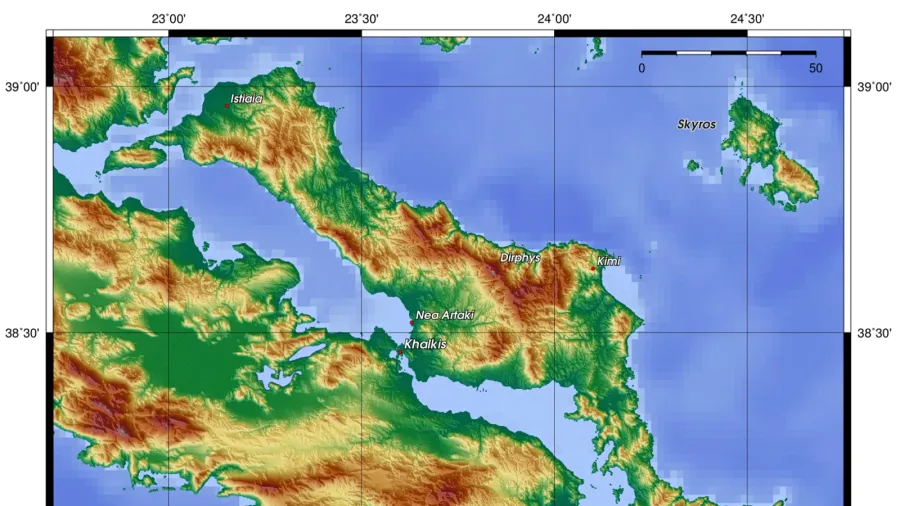
Along the northeastern coast of the island of Euboea, modern fishing villages and rocky bluffs conceal the footprint of ancient Greek settlements that once held formal membership in maritime alliances. Among these classical settlements was Diacria (Ancient Greek: Διακρία), a community documented in Athenian imperial archives and Hellenistic poetry. Though its physical foundations remain buried beneath centuries of Mediterranean vegetation and coastal sediment, epigraphic records preserve its existence as an active contributor to fifth-century BCE geopolitics.
The geographical term Diacria derived from the Greek word for mountainous or upland terrain, designating communities positioned along rugged slopes. On Euboea, the town occupied territory near the modern settlement of Pili on the Aegean-facing coastline. Unlike the sheltered gulf waters separating Euboea from mainland Boeotia and Attica, this outer coast faced the open sea, exposing ships to unpredictable currents, seasonal north winds, and precipitous rocky promontories.
 Figure 1: Classical masonry along the acropolis fortifications of Eretria on the island of Euboea.
Epic prophecy and the ships of the Trojan War
Diacria enters classical literature through the Cassandra, also known as the Alexandra, a dramatic monologue attributed to the Hellenistic poet Lycophron. In this obscure poem, Cassandra foretells the disasters awaiting Greek warriors returning home after the sack of Troy. Punished by Athena and Poseidon for their transgressions, the Hellenic fleet encounters violent storms around the Caphirean rocks of southeastern Euboea.
Lycophron identifies the territory of the Diacrians as one of the specific shores where shipwrecked survivors would wash ashore. According to the mythological tradition, Nauplius, king of Euboea, sought vengeance for the execution of his son Palamedes by lighting false signal fires along the jagged cliffs. Greek sailors steered toward the deceptive lights only to shatter their hulls against submerged reefs. The surviving mariners sought refuge across the rugged hillsides of Diacria, establishing local lineages and burial mounds remembered in regional folklore.
While the Homeric epics do not mention Diacria by name, Lycophron drew upon archaic regional legends to construct his geographical catalog. The association of Diacria with treacherous maritime passages highlights the perilous navigation that characterized the eastern coastline of Euboea in antiquity.
 Figure 2: Defensive stone circuits of ancient Euboean city-states that commanded regional maritime approaches.
Imperial taxation in the Delian League
Beyond mythological accounts, Diacria appears as a verifiable historical entity in the Athenian Tribute Lists. In the aftermath of the Persian Wars, Athens organized the Delian League to defend Greek maritime poleis and liberate Aegean islands. Over decades, this alliance transformed into the Athenian maritime empire, with member cities paying annual financial contributions, known as phoros, to maintain the imperial trireme fleet.
Epigraphic fragments carved into marble stelae on the Athenian Acropolis document Diacria’s tax assessments during the Peloponnesian War. The town is inscribed on the tribute assessment of 429/428 BCE, a period when Athens extracted heightened contributions to fund military campaigns against Sparta and its allies. The community appears again on the tribute quota lists of 417/416 BCE, demonstrating continuous administrative standing during the Peace of Nicias.
An Athenian financial decree from 425/424 BCE provides further geographical precision by listing both Diacria and a separate entity known as Diacres or Diacres of the Chalcidians. Scholars note that the distinction between these two entries confirms they were separate fiscal jurisdictions on Euboea. While Diacres belonged to the sphere of Chalcis on the central Euripus strait, Diacria operated within the coastal orbit of northern and central Eretrian territory.
 Figure 3: Mountainous ridges of central Euboea rising behind ancient coastal territorial settlements.
Topography, demes, and archaeological search
The precise civic status of Diacria within Euboean political geography remains a subject of ongoing debate among classical historians. epigraphists and archaeologists have proposed that Diacria was an autonomous coastal polis that later integrated into the territorial system of Eretria as a dependent deme. In classical times, Eretria controlled a extensive rural territory partitioned into administrative districts, including a northern coastal district designated as Peraea.
Historical geographers often identify the territory of Diacria with the environs of modern Pili, where natural coves provided seasonal anchorages for fishing craft and coastal traders. The surrounding hills supplied timber for ship construction and supported olive cultivation on terraced slopes. The isolation of the northeastern coast meant that communities like Diacria functioned as maritime lookout stations, monitoring sea lanes between the Aegean islands and the northern Sporades.
Surveys along the coastline near Pili have revealed scattered potsherds dating from the Classical and Hellenistic periods, but systematic excavation has not yet uncovered civic foundations, temples, or inscribed boundary stones. The town may have suffered depopulation during the late Hellenistic era, when coastal piracy and economic shifts prompted inhabitants to move inland or concentrate within the fortified urban centers of Chalcis and Eretria.
Today, Diacria survives primarily on damaged Athenian marble slabs and in scholarly reconstructions of classical fiscal geography. Its trajectory reflects the fate of numerous small Aegean poleis that contributed grain, taxes, and rowers to imperial fleets before quietly receding from the historical record.