· Earth Enigmas · 4 min read ·
Hoa Hakananai'a: The Stolen Basalt Moai of Rapa Nui's Birdman Cult
Quarried from dense basalt on Rapa Nui and removed in 1868, the moai Hoa Hakananai'a preserves the rare transition from ancestor worship to the birdman cult.
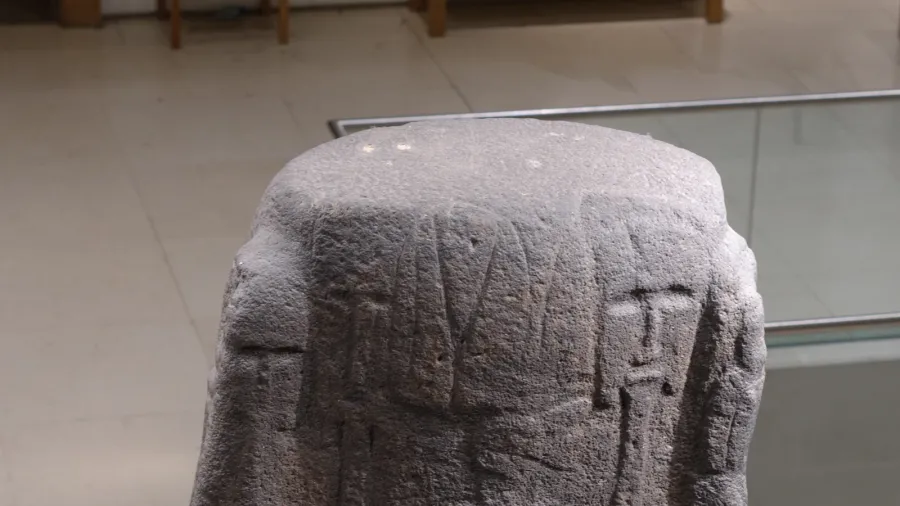
In November 1868, the crew of the Royal Navy frigate HMS Topaze anchored off Rapa Nui and hauled a four-ton basalt monolith from the ceremonial village of Orongo down to the Pacific surf. That statue, known in the Rapa Nui language as Hoa Hakananai’a, translates roughly to “lost or stolen friend.” Today, it stands beneath the glass roof of the Great Court at the British Museum in London, thousands of kilometers from the volcanic crater where Polynesian carvers shaped it centuries ago.
 Figure 1: Hoa Hakananai’a on display at the British Museum, carved from dense dark gray flowlava basalt.
Basalt Rather Than Tuff
Nearly ninety-five percent of the almost nine hundred known moai on Easter Island were quarried from the compressed volcanic ash of Rano Raraku. That yellowish-brown tuff is porous, relatively soft, and prone to weathering over centuries of exposure to salt wind. Hoa Hakananai’a belongs to an exclusive group of fewer than twenty statues carved instead from dense, fine-grained basalt originating near the Rano Kau crater.
Measuring 2.42 meters in height and weighing approximately 4.2 metric tons, the monolith is smaller than the towering giants lining the coastal platforms of Ahu Tongariki. However, the extreme hardness of the basalt allowed Rapa Nui stoneworkers to achieve a level of surface polish and crisp anatomical detail impossible in softer volcanic tuff. The heavy brow ridge, elongated ears, concave nose, and pursed lips exemplify the classic style of ancestral sculpture created between 1200 and 1500 CE.
 Figure 2: Detailed view of the stylized hands and abdominal carving across the lower torso of the basalt statue.
A Palimpsest of Two Religious Eras
What elevates Hoa Hakananai’a into an archaeological anomaly is the contrast between its front and its back. While the front face honours the traditional cult of deified ancestors, the rear surface records an ideological revolution on the island. As timber resources dwindled and ecological stress mounted across Rapa Nui after the sixteenth century, the labour-intensive carving of giant moai ceased. In its place arose the Tangata Manu, or birdman competition, centered at the cliffside village of Orongo overlooking the sea stacks of Motu Nui.
Generations after Hoa Hakananai’a was originally sculpted, artisans carved low-relief petroglyphs directly across the smooth basalt of its back and shoulders. Flanking the spine are two facing birdmen with human limbs and the hooked beaks of the great frigatebird. Above them sits the ceremonial paddle known as an ao, alongside representations of the female vulva, called komari, added during subsequent initiation rites.
 Figure 3: The dorsal petroglyphs of Hoa Hakananai’a, featuring twin Tangata Manu figures and ceremonial symbols added during the Orongo birdman era.
Instead of destroying the older ancestral figure, the priests of Orongo embedded it half-buried inside a stone ceremonial house named Taua Renga. Set into the earth up to its elbows, the statue stood in darkness, illuminated only during the spring equinox when sunlight entered the low stone crawlway. Modern reflectance transformation imaging has confirmed that the back carvings were repeatedly painted in red ochre and white coral lime, turning the dark stone into a vivid ritual canvas.
The 1868 Extraction by HMS Topaze
When Commodore Richard Powell brought HMS Topaze to Easter Island in late 1868, his officers began surveying the island for antiquities to present to the British Admiralty. Guided by islanders and resident missionary Hippolyte Roussel, Lieutenant Colin Dundas and the ship’s surgeon William Palmer located the statue inside its subterranean stone chamber on the rim of Rano Kau.
 Figure 4: Archival sketches executed by Lieutenant Colin Dundas in 1868, documenting the red and white pigment still visible when the statue was brought aboard HMS Topaze.
Removing the monolith required dismantling the roof of the stone house and mobilizing hundreds of sailors and Rapa Nui residents to drag the four-ton figure down the steep volcanic slope. Floated out to the frigate on a raft, the statue was washed clean during the voyage to Valparaíso and Plymouth, stripping away most of the original red and white mineral pigments recorded in Dundas’s field watercolors. Queen Victoria subsequently gifted the monument to the British Museum in 1869. In recent years, indigenous delegations from Rapa Nui have formally petitioned London for the return of Hoa Hakananai’a, arguing that the statue remains a living embodiment of ancestral mana rather than a static museum artifact.