· Earth Enigmas · 4 min read ·
The 171-Foot Desert Giants Built for Skyward Eyes
Scraped into the sun-scorched gravel of the Colorado Desert lie colossal figures up to 171 feet long, designed to be seen only from the heavens.
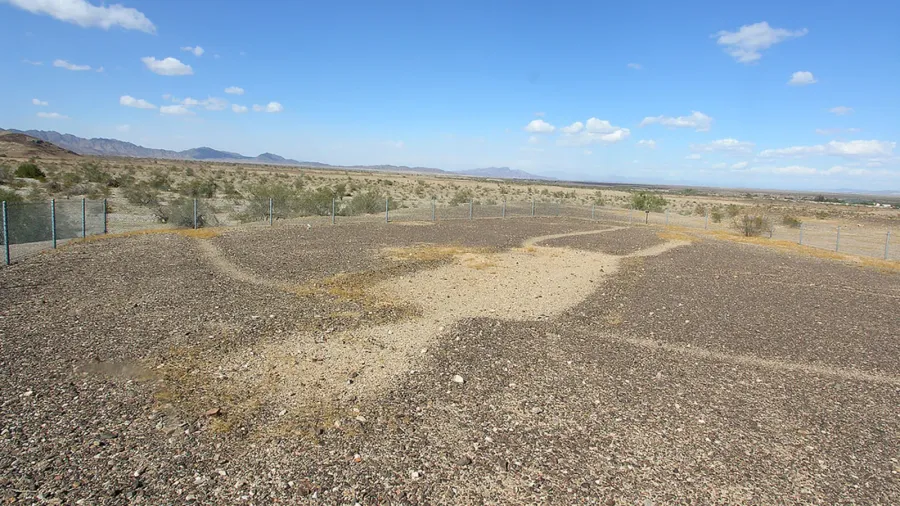
In 1932, a pilot named George Palmer glanced out the window of his biplane cruising over the gravel terraces north of Blythe, California. Below his wings, the harsh desert floor revealed an impossible sight: a pair of colossal human silhouettes stretched across the desert pavement, their limbs extended toward the horizon. From the ground, walking among the jagged stones and creosote bushes, a person could stand directly inside these lines and perceive nothing more than random tracks or cleared dirt. Only from hundreds of feet in the air did the scattered clearings resolve into immense, deliberate works of human art.
These monumental ground drawings are the Blythe Intaglios, North America’s most famous desert geoglyphs. Carved on the flat alluvial terraces east of the Big Maria Mountains along the Colorado River, the figures include three human effigies, two four-legged animals, and a geometric spiral. The largest human figure spans an astonishing 171 feet from head to toe. For centuries, these figures went unrecorded by non-Native travelers who passed along the Colorado River basin, hidden entirely by their sheer scale.
 Figure 1: The primary anthropomorphic figure stretches 171 feet across the desert terrace, its form only discernible from high above the ground.
The engineering technique behind the intaglios is remarkably simple yet durable. Over thousands of years, sun, wind, and trace minerals create desert varnish, a dark brown patina of iron and manganese oxides coating the surface pebbles. Ancient artisans created the geoglyphs by manually scraping away this darkened crust, exposing the lighter-colored alkaline soil underneath. They piled the displaced dark stones along the outer margins to outline the figures, and then tamped down the cleared earth. Compacting the ground hindered plant growth, preserving the bare shapes across centuries of scorching heat and flash floods.
More than 200 intaglios dot the Colorado Desert, yet the Blythe group remains unique. While desert pictographs across southeastern California depict abstract geometric symbols, serpents, and mountain lions, anthropomorphic human figures appear almost exclusively along the Colorado River corridor. The spatial arrangement suggests an integrated ceremonial complex rather than isolated drawings.
 Figure 2: A 54-foot quadruped figure etched beside an anthropomorphic form, representing animal spirits deeply woven into regional oral traditions.
Determining when and why these figures were created has challenged archaeologists for decades. Local indigenous nations along the lower Colorado River, including the Mohave, Chemehuevi, and Quechan, incorporated the figures into their ritual practices and oral traditions. In Mohave cosmology, the giant human figures are associated with Mastamho, the creator spirit who crafted the Colorado River and gave life to all living things. The animal figures often represent Hatakulya, one of the two mountain lion brothers who assisted in world creation. However, contemporary tribes do not claim direct authorship of the carvings, describing them instead as ancestral features established at the beginning of time.
Dating gravel intaglios is notoriously difficult because stone lacks organic carbon. In the 1990s, archaeologist Jay von Werlhof conducted accelerator mass spectrometry (AMS) radiocarbon analysis on organic matter trapped beneath the rock varnish and within the desert soil. The thirteen sample dates spanned from 900 BCE to 1200 CE, indicating that the site was maintained and perhaps repeatedly modified over two millennia. Some researchers argue that certain quadruped carvings depict horses, which would place their creation after the Spanish introduced equines in the 16th century, though others identify the animals as bighorn sheep or cougars.
 Figure 3: Detailed view of the second human effigy, framed by protective fencing installed to prevent vehicular degradation of the fragile desert pavement.
Today, the Blythe Intaglios stand under federal protection by the Bureau of Land Management, surrounded by wire fencing to protect them from off-road vehicles and foot traffic. The desert varnish that took millennia to form can be destroyed in seconds by a single tire tread. Preserved against the elements, these massive figures remain physical records of the sophisticated spatial planning of ancestral desert peoples, etched into the crust of the earth to speak directly to the sky.