· Cities & Capitals · 4 min read ·
Gniewkowo: The Piast Duchy That Defied the Teutonic Order
From a medieval Piast duchy burned to escape Teutonic siege to wartime resistance in Kuyavia, Gniewkowo preserves centuries of resilient Polish history.
Located between Inowrocław and Toruń in the historic plains of Kuyavia, the town of Gniewkowo represents one of north-central Poland’s most enduring medieval foundations. First documented in 1185, this settlement evolved from an early Piast defensive outpost into the capital of an autonomous duchy, surviving Teutonic invasions, Swedish wars, and twentieth-century occupation. The town’s street plan and brick monuments record more than eight centuries of political shifts along the frontier between Greater Poland and Pomerania.
 Figure 1: The Church of Saints Nicholas and Constance, a medieval brick sanctuary in Gniewkowo.
The Piast outpost and the Duchy of Gniewkowo
Archaeological excavations confirm that the fertile territory around Gniewkowo supported agrarian populations as early as the Bronze Age. By the twelfth century, the Piast rulers recognized the military value of the site, establishing a fortified settlement along the trade corridors crossing the Noteć basin. Gniewkowo obtained municipal privileges under Magdeburg law in 1268, securing market rights and administrative autonomy.
In 1314, following the death of Duke Siemomysł of Inowrocław, his Kuyavian territory was partitioned among his three sons. Casimir III of Kuyavia inherited the district, establishing the independent Duchy of Gniewkowo. Positioned on the front line of Poland’s confrontations with the State of the Teutonic Order, the small duchy faced immediate existential threats. When Teutonic forces besieged the town in 1332, Duke Casimir burned his own fortress rather than surrender it, retreating until the Treaty of Kalisz restored his lands in 1343. His son, Duke Władysław the White, later mortgaged the territory to King Casimir the Great in the 1360s, permanently integrating Gniewkowo into the royal domain of the Kingdom of Poland.
 Figure 2: Archival photograph showing Sobieski Street in Gniewkowo during the interwar period in 1925.
Imperial partition and industrial railway expansion
Throughout the early modern period, Gniewkowo functioned as a royal administrative seat within the Inowrocław Voivodeship. Repeated urban fires during the sixteenth century and destruction during seventeenth-century Swedish invasions curtailed municipal growth. The town’s political status changed dramatically in 1772, when the First Partition of Poland transferred Kuyavia to the Kingdom of Prussia.
Prussian rule introduced intensive Germanisation policies, culminating in 1879 when imperial authorities replaced the historic Polish name with the German designation Argenau. When German was mandated for religious instruction in local classrooms, Polish families initiated student strikes to protect their language rights. Despite cultural suppression, the late nineteenth century brought modern infrastructure. In 1873, the opening of the Poznań-Toruń railway line, now Polish state line 353, linked Gniewkowo to regional industrial networks, followed by municipal electrification in 1908. Following the 1918 Greater Poland Uprising, Polish volunteer forces engaged retreating imperial troops, formally returning Gniewkowo to sovereign Polish governance in January 1920.
 Figure 3: Memorial obelisk in the Gniewkowo forest dedicated to the thousands executed during World War II.
Wartime terror and modern memory
German forces invaded Gniewkowo on September 2, 1939, initiating a brutal occupation under the Reichsgau Danzig-West Prussia. Nazi authorities systematically demolished civic monuments, including the prewar memorial honoring Greater Poland Uprising veterans. Between 1939 and 1943, the surrounding pine forests became an execution site for Operation Intelligenzaktion. German police battalions and paramilitary units transported approximately 4,000 Polish citizens from Gniewkowo, Toruń, Bydgoszcz, and Inowrocław into the woods, executing teachers, doctors, priests, railway personnel, and municipal officials in mass graves. Between 1944 and 1945, the regime also established a female forced-labor subcamp affiliated with the Stutthof concentration camp within the municipality.
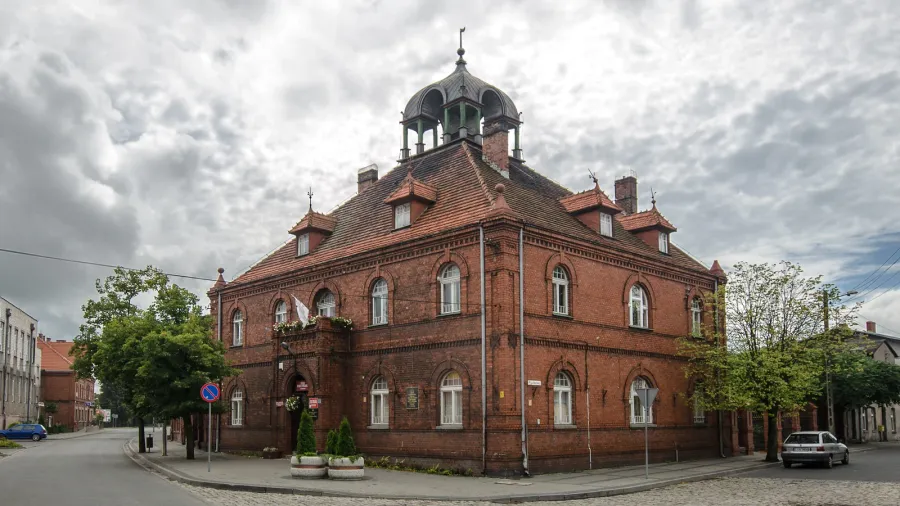
Following liberation by Polish and Soviet forces on January 21, 1945, the town sustained active underground anti-communist networks, including units of the Home Army and Freedom and Independence. With Poland’s democratic transition in 1989, Gniewkowo restored municipal self-government. Today, memorial sites in the Gniewkowo forests mark the wartime burial pits, while the restored medieval Church of Saints Nicholas and Constance and the historic town hall anchor the urban heritage of this Kuyavian crossroads.