· Castles & Palaces · 4 min read ·
Arad Fort: The Coral Stone Citadel Guarding Bahrain's Seas
Built from coral limestone and palm wood, the 15th-century stronghold of Arad Fort controlled strategic sea passages across the Arabian Gulf.
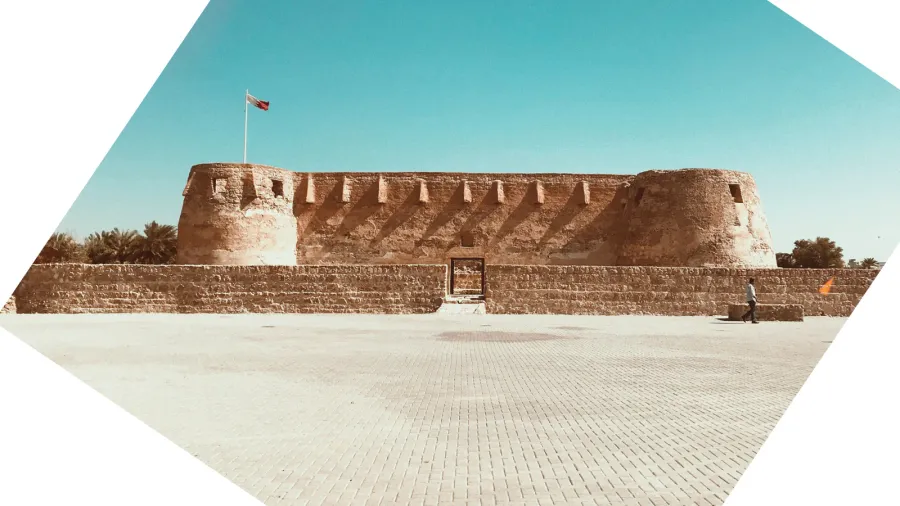
Guarding the coastal approaches to Muharraq in northern Bahrain, Arad Fort represents one of the finest surviving examples of pre-modern Islamic military architecture in the Arabian Gulf. Constructed during the fifteenth century on what was once an isolated barrier island, the compact fortress commanded shallow littoral passages connecting the open waters of the Gulf with the natural harbors of Bahrain. While modern land reclamation has fused the surrounding island of Arad with Muharraq, the fortress retains its original geometric clarity and coastal positioning.
 Figure 1: The outer trench and sea-stone perimeter walls of Arad Fort overlooking Muharraq.
Coastal defense on a former barrier island
Before twentieth-century civil engineering altered Bahrain’s coastline, Arad Fort stood on a distinct island separated from Muharraq by a tidal channel. This aquatic frontier provided exceptional passive protection against maritime assault. Navigating the surrounding shallows required intimate knowledge of submerged sandbars and fluctuating tides, allowing local sailors to deny foreign galleys access to the deeper lagoons. The fortress was strategically placed to overlook the narrowest nautical passages, enabling defenders to intercept merchant convoys and military flotillas approaching from the north and east.
To augment this natural moat, the fortress designers excavated an artificial ditch around the square curtain walls. In an arid maritime environment where seawater could undermine foundations, engineers drilled specialized freshwater wells into coastal aquifers to supply the perimeter moat. This water barrier prevented siege parties from undermining the perimeter walls while supplying the defenders with potable water during naval blockades.
 Figure 2: The central courtyard and cylindrical towers designed according to classical Islamic fortification principles.
Coral masonry and classical Islamic military design
The layout of Arad Fort adheres to classical Islamic geometric design. The stronghold forms a compact square roughly thirty meters on each side, anchored at every corner by a sturdy cylindrical tower. Rather than using quarried terrestrial granite or imported brick, builders constructed the ramparts entirely from local marine resources. Workers harvested sea stone (fushisht) and fossilized coral blocks directly from coastal shoals, bonding them with traditional mortar made from slaked lime, crushed shells, and quartz sand. Structural lintels, ceiling supports, and roof joists were fashioned from date palm trunks, an organic building material resilient against high humidity and coastal salinity.
The defensive walls feature two distinct levels of fire. Lower walkways allowed infantry to direct arrows and early musketry fire through vertical slits, while the upper parapets accommodated larger artillery pieces and perimeter sentries. Each cylindrical corner tower projects outward from the curtain wall, establishing overlapping fields of fire that eliminated blind spots along the base of the fort. Cantilevered protruding balconies, known regionally as nose-shaped machicolations, crown the upper parapets, allowing defenders to pour burning liquids and project projectiles directly onto attackers attempting to breach the entrance gate.
 Figure 3: Defensive machicolations and cantilevered firing slits positioned to command maritime channels.
Shifts of power in the Arabian Gulf
Over four centuries, Arad Fort served as an active theater during regional conflicts among Gulf polities, the Persian Empire, the Portuguese Empire, and Omani fleets. Erected prior to the Portuguese conquest of Bahrain in 1521, the fort functioned as an auxiliary coastal station guarding the sea approaches while Qal’at al-Bahrain served as the central garrison. Following the expulsion of the Portuguese in the early seventeenth century, Persian and local tribal authorities intermittently garrisoned the fort to protect coastal fisheries and lucrative pearl diving grounds.
At the turn of the nineteenth century, Sultan bin Ahmad of Oman seized the fortress during his military campaign to dominate Gulf shipping routes, appointing his son Said bin Sultan as governor and using Arad as his primary headquarters. Subsequent skirmishes returned the fortress to the ruling Al Khalifa dynasty, who consolidated Bahrain’s maritime sovereignty. After falling into ruin in the mid-twentieth century, the Bahraini Ministry of Culture oversaw an extensive conservation initiative. Conservators analyzed the historic coral masonry, employing traditional lime plaster, sea stones, and palm timbers to restore the citadel to its fifteenth-century condition.