· Castles & Palaces · 6 min read ·
Annevoie Castle: The 18th-Century Gravity Water Gardens
Built in 1758 by an ironmaster, Belgium's Annevoie Castle powers dozens of baroque fountains, canals, and cascades using pure gravity without a single pump.
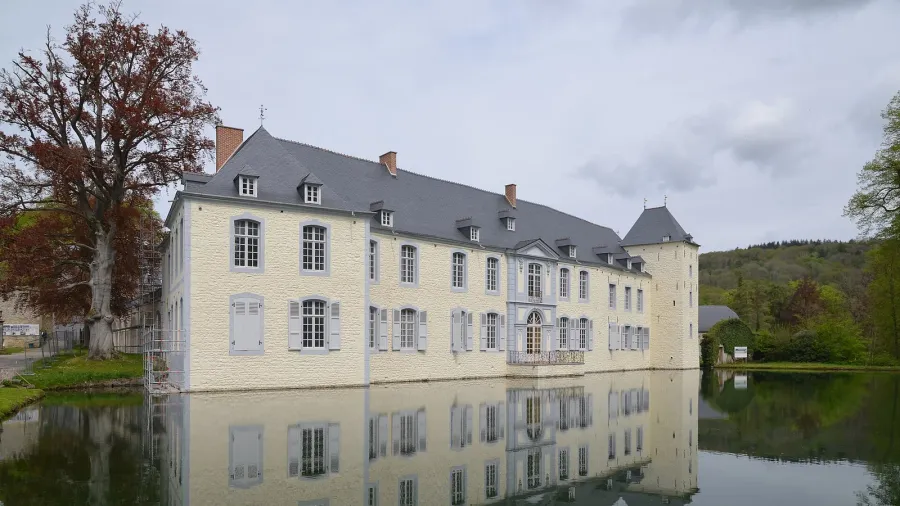
Deep in the Meuse river valley of Wallonia, midway between Namur and Dinant, water jets erupt toward the tree canopy, feed tranquil reflecting pools, and tumble over stone cascades without the hum of an engine or the draw of an electric grid. Annevoie Castle, known locally as the Château d’Annevoie, preserves the only historic water gardens in Belgium. What appears at first glance to be an ornamental estate built purely for aristocratic pleasure is actually one of Europe’s most sophisticated 18th-century hydraulic laboratories, operating continuously since 1758 through hydrostatic pressure and gravitational force alone.
At a time when royal estates like Versailles relied on monumental, failure-prone machinery such as the Machine de Marly to pump water uphill from the Seine, Annevoie bypassed mechanical pumping entirely. Its creators turned the natural hydrology of the Condroz plateau into a self-sustaining engine. Every fountain jet, canal basin, and stepped cascade functions through the conservation of energy and the fluid mechanics of communicating vessels, creating an unbroken hydrological loop that has outlived the dynasty that designed it.
 Figure 1: The elongated limestone façade of Annevoie Castle mirrored in the lower reflecting basin, where discharge waters gather before exiting to the River Rouillon.
The Forge Master’s Laboratory
The origin of Annevoie’s waterworks lies in heavy industry rather than aristocratic leisure. In 1691, Jean de Montpellier, an influential ironmaster and Seigneur of Yvoir, acquired the domain through marriage into the de Halloy family. In the 17th and 18th centuries, the Namur region stood at the forefront of European iron metallurgy. Operating forge hammers and blast furnaces required absolute mastery of watercourses. Ironmasters dammed streams, directed flumes, and calculated hydraulic head to generate mechanical horsepower.
When Jean’s grandson, Charles-Alexis de Montpellier (1717–1807), inherited the estate in the mid-18th century, he held the prestigious title of Mayor of the Ironmasters of the County of Namur. Charles-Alexis approached the grounds surrounding his manor not as an idle courtier, but as an engineer trained in hydrodynamics and metallurgy. Traveling extensively across France, Italy, and England, he observed the immense capital costs and frequent breakdowns of mechanical water pumps in contemporary pleasure gardens. Upon returning to the family seat in Annevoie-Rouillon, he spent twenty years transforming the natural valley of the Rouillon River into a gravity-fed water sanctuary.
 Figure 2: Mythological stone figures stand sentinel along the terraced hillside, where hidden underground conduits feed stepped cascades and side channels.
The Physics of the Elevated Reservoir
The technical secret behind Annevoie lies in its topography and a subtle network of hidden reservoirs. Rising above the castle, the surrounding hills capture precipitation in a limestone aquifer. Charles-Alexis identified four perpetual springs on the high plateau and channeled them into a central feeder canal known as the Grand Canal, perched several meters above the estate.
By holding thousands of cubic meters of water at elevation, the Grand Canal creates a continuous hydraulic head. Buried underground, a network of sealed lead, wood, and cast-iron conduits snakes down the hillside to the garden features below. Because water seeks its own level through communicating vessels, the elevation difference between the high plateau canal and the lower garden basins creates sufficient hydrostatic pressure to drive water upward through narrow brass nozzles, generating vertical fountain plumes reaching heights of up to seven meters.
Unlike standard municipal systems or modern recirculating pumps, the water at Annevoie never loops backward. The entire garden operates as a pass-through hydraulic circuit. Water flows from the highland springs through the Grand Canal, descends through the underground pipes to supply fountains such as the Buffet d’Eau and the Neptune basin, spills into the lower reflecting ponds, and discharges into the Rouillon River, which carries it into the Meuse. Because the system depends solely on gravity and atmospheric pressure, it operates without fuel, gears, or ongoing electrical input.
 Figure 3: View of the central 18th-century chateau viewed across the primary upper watercourse, demonstrating the strict alignment of hydraulic axes.
A Tri-Continental Landscape Synthesis
While the subterranean mechanics represent advanced hydraulic engineering, the visible grounds reflect a deliberate aesthetic synthesis. During his Grand Tour travels in the 1750s, Charles-Alexis de Montpellier absorbed three distinct European landscape philosophies, which he fused into a coherent whole at Annevoie.
The central perspective follows the French formal tradition established by André Le Nôtre. Long, straight allées of hornbeam hedges and limestone balustrades frame axial views of the château façade, enforcing geometric order and symmetry along the valley floor. Yet where French gardens celebrate grand, static water mirrors, Annevoie integrates the dramatic, theatrical water features of the Italian Renaissance. Inspired by the Villa d’Este in Tivoli, Charles-Alexis installed grottoes, artful cascades, and the celebrated Buffet d’Eau, where water steps downward across sculpted tiers directly opposite the manor’s dining salon.
Surrounding these formal axes, the outer perimeters dissolve into the emerging English romantic landscape style. Winding paths, irregular ponds, weeping willows, and sudden woodland clearings give visitors the impression of untamed wilderness. This hybrid design makes Annevoie unique in garden history: it shifts seamlessly between Cartesian geometry, Baroque water spectacle, and romantic naturalism within a single continuous twenty-hectare park.
 Figure 4: The intersection of formal canal margins and naturalized spring reservoirs, showing the careful gradation between architectural precision and organic landscape.
Two and a Half Centuries of Hydraulic Continuity
Eleven successive generations of the Montpellier family maintained Annevoie, preserving its original underground pipe networks through the French Revolution, the industrial expansion of Belgium, and both World Wars. In 1982, the Belgian state classified the entire complex of buildings, gardens, and waterways as an official Historic Monument.
The absence of mechanical pumps proved both the system’s greatest strength and its primary vulnerability. Because the network relies on clean gravity feeds, sediment accumulation, mineral encrustation, and tree root intrusion can disrupt water flow. In the early 2000s, administrative neglect led to structural deterioration, causing the site to temporarily lose its exceptional heritage classification.
A comprehensive restoration initiative launched in 2017 under the private Foundation Domaine Historique d’Annevoie, supported by the King Baudouin Foundation, revitalized the 18th-century hydraulic infrastructure. Hydrologists and stone masons cleared historical conduits, repaired limestone spillways, and stabilized natural spring sources without introducing modern electric pumps. Today, Annevoie stands as an enduring case study in sustainable hydraulic engineering, proving that pre-industrial design can achieve perpetual motion in water management using nothing more than topography, gravity, and patient human ingenuity.