· World Landmarks · 3 min read ·
Why a 51-Meter Spiral Spire Dominates the Skyline of Northern Ethiopia
Rising 51 meters above Mekelle, the Tigray Martyrs Memorial Monument immortalizes a grueling 17-year guerrilla war that toppled Ethiopia's Derg dictatorship.
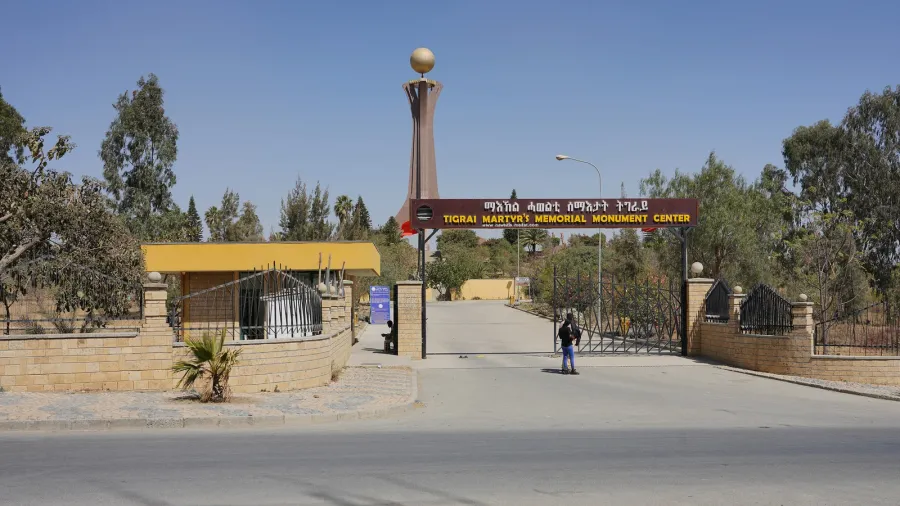
Across the windswept limestone plateaus of northern Ethiopia, the afternoon shadow of a concrete needle stretches across the city of Mekelle like the hand of a colossal sundial. Rising 51 meters into the thin highland air, the monument coils toward the sky in an unbroken architectural spiral before terminating in a gleaming polished sphere. From a distance, its austere geometry resembles a piece of futuristic engineering, yet the bas-relief sculptures wrapping its base tell a far grimmer story of twentieth-century survival: barefoot peasant militias, women fighters bearing rifles, and the bloody overthrow of one of Africa’s most ruthless military dictatorships.
The Crucible of the Seventeen-Year War
Known locally in Tigrinya as Hawelti Semaetat, the Tigray Martyrs Memorial Monument was conceived in the immediate aftermath of the Ethiopian Civil War. For seventeen years, between 1974 and 1991, the northern province of Tigray served as the main battleground in the armed struggle against the Derg, the Soviet-backed Marxist-Leninist military junta led by Mengistu Haile Mariam.
The conflict devastated the Horn of Africa. The Derg deployed MiG fighter jets, scorched-earth sweeps, and weaponized famine against civilian populations suspected of harboring guerrilla fighters of the Tigray People’s Liberation Front (TPLF). When rebel forces finally marched into Addis Ababa in May 1991, driving Mengistu into exile, the victory carried a catastrophic human toll: over 60,000 regional fighters had died in combat, with more than 100,000 permanently wounded.
 Figure 1: Towering 51 meters over the Adi-Haki district of Mekelle, the Hawelti Semaetat culminates in an elevated sphere visible across the Tigrayan plateau.
Architecture of Defiance and Memorialization
To anchor this sacrifice into the civic landscape, regional leaders commissioned a grand monument complex in Mekelle’s Adi-Haki district. Begun in 1992 and completed near the end of the decade, the 51-meter tower was engineered to dominate the visual horizon of the regional capital.
The structure’s coiled spire incorporates elements of traditional Ethiopian obelisks, such as the ancient stelae of Axum located eighty miles to the northwest, while reinterpreting them through the monumental modernist vocabulary common to late twentieth-century liberation movements. The spiral symbolizes the protracted, winding course of the armed struggle, ascending through hardship toward the crowning golden sphere, which represents collective liberty and peace.
At the foot of the tower, bronze figurative sculptures depict the mobilization of rural society. Sculpted friezes show agrarian laborers, radio operators hiding in mountain caves, and field medics tending wounded guerillas. An eternal flame burns in a sunken circular court, flanked by commemorative plaques honoring fallen combatants.
 Figure 2: The sprawling urban basin of Mekelle sits framed by high limestone ridges, with the memorial spire commanding the city’s western approach.
The Subterranean Vaults and Political Continuity
Beyond its outdoor esplanade, the monument houses an extensive historical museum and documentation center built into the hillside beneath the podium. The museum galleries preserve physical relics of the bush war: captured Soviet weaponry, clandestine printing presses used to publish underground resistance journals, medical equipment fabricated from scrap metal, and graphic photographic archives documenting the 1988 Hawzen air market bombing.
The site also includes an amphitheater, a public library, and terraced parkland planted with indigenous drought-resistant flora. Because of its commanding view of the surrounding mountain ridges, the complex quickly evolved from a somber memorial into the symbolic political heart of Tigray. Decades after the defeat of the Derg, the monument continues to serve as a potent cultural anchor, embodying the fragile interplay between memory, sacrifice, and political identity in the highlands of the Horn of Africa.